| GREEN
FINGER TIPS
Return to Home Page
November December January February March April May June July August September October
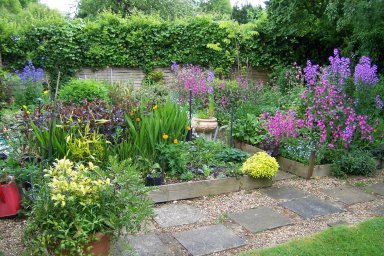
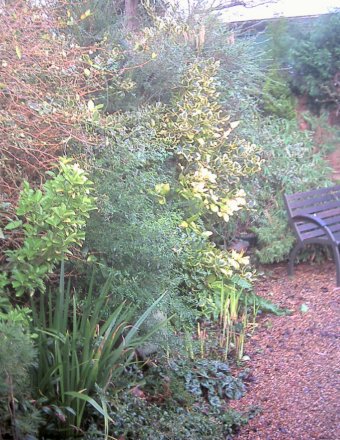
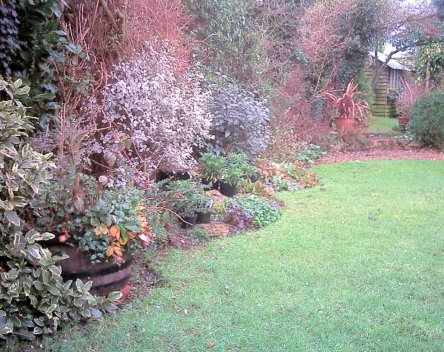
As you can see from May to September there isn't much time for writing gardening tips. There is too much to do, including sitting and relaxing in the garden. But then, if you have done all the work in the winter, there is less to do in the summer, except look after and tend your plants. Planting, feeding if necessary, deadheading, keeping an eye out for pests and diseases at an early stage, and mowing the lawn regularly are pretty much the stuff of summer gardening and don't need a lot in the way of tips. (That's my excuse anyway) November 7th 2004 - Fuchias in 'cauldrons' stay out until the first frosts drop the leaves, then they are tidied up and overwintered frost free with minimal watering. The Shrub is the beautiful evergreen Pittosporum 'Garnet' that is at its most spectacular over the winter. There is a deep red one Atropurpurea, and its miniature version 'Tom Thumb' - the only hardy evergreen this of colour to my knowledge- superb in winter sunshine and especialy when wet. More information on autumn and plants on the link below. Now is the time to look at how bright or dull your garden is at the start of the winter. A good backbone of green, gold and variegated evergreen shrubs.trees and climbers will give value all year round. A foil for flowers and deciduous plants in the spring and summer, and colour and ecological value for birds and overwintering insects through the winter. Autumn should be as colourful as any other season in your garden - Click Here There is lots of work now clearing the dying tops of herbaceous perennials onto your compost heap. Cut woody stems to help composting. If you only have one compost bin, heap the new stuff separately until you have got the mature compost out onto the ground (no need to dig it in, the worms will mix it in over the winter) See further down this site for previous autumn notes. Large tender plants such as Citrus, Plumbago and Oleander and half hardy fuchias, need to be ready to be sheltered from frost. Deciduous ones do not need light and could be kept in a frost free shed or garage. Trim back extraneous growth and check for pests and diseases. Most need to be kept cool or very cool over the winter. November 2003 All the rain made it late getting all the clearing of leaves from the paths, shingle and grass and onto the ground under the shrubs and into bags to go into the leafmould bin when I get round to taking the things off the top. They should ideally be composted separately, because they are mainly broken down by fungi. The main thing is that they must be moist or they will just dry and not rot down. If there is a dry spell it is a good idea to spread the leaves onto a lawn and get them up using a lawn mower. This way, you get a fine mixture of chopped up leaves with grass cuttings that add nitrogen to the finished product. It composts more quickly better too. Before Christmas I like to go round and cut back herbaceous perennials, and generally tidy up, replacing pots with fuchsias and summer bedding plants with pots of bulbs, I love Tulips, and Wallflowers, either together or in separate pots. Once this is done and the shrubs and trees have been cut back if necessary, this year they put on a lot of growth and my tall mixed hedge needed a really good chopping back, particularly as it is on the south side of a border that is already fairly shady. This border looks good from the house in the winter as it has a lovely pale green/white Pittosporum and grey green Daisy Bush, both evergreen that look good together, fronted by a scalloped front border planted with large clumps of Heuchera, Pulmonaria, Omphaloides - in several colours, and all evergreen and about the same height, about 9-12"
December 2003 Still clearing up, at last a dry enough period to blow the leaves off the shingle and paths. The herbaceous plants have been cut down, mulched with leaves and garden compost and simple wire 'hurdles' and viciously barbed Berberris twigs, suitably placed to keep the cats off. Muscle engaged to help deconstruct the compost heap, a bit late this year. Good stuff though, we didn't get round to doing it last year so there a an awful lot. I got some put out on the ground for the worms and weather to dig in over the winter (that's the ideal) but I also have some in bags to spread as I get round to it. (there is a web-page on compost heaps elsewhere on the site). Keeping an eye on garden pot plants under cover for the winter, fuchsias and alpines. Care must be taken not to let them keep soft damp foliage that will go mouldy if not cut back Bird feeders are up with nuts and wild bird seed (I will put a handout on the subject of planting to give protection and food in the winter) I like the garden to look as good (if not the same) in the winter as in the summer, which is a bit difficult if it is very wet. But a good backbone planting of winter interest plants and shrubs does the job. Soon the spring bulbs will be showing along with Helebores and spring flowers, as well as the autumn planted pots. When planting winter and spring flowers, put them where you see them from the house (unless they are for picking) but at the back of the border, not the front. This way as they die down, you have later plants looking good in front of them. If you put them at the front you will see the dying foliage for weeks. The more work you do in the winter, when it is cold, the more time you will have to spend messing about in the spring and summer, and sitting down to enjoy the garden at its best!
January 2004 We had a bunch of roses in the bathroom over Christmas & they still have leaves and buds developing from last year - that's a first. More pruning (but not prunus) of trees and late flowering shrubs, most will grow from where you cut them above good new buds, but don't go too mad until the danger of really bad weather is past or you will not have new buds lower down to fall back on. Don't be timid with climbers, if you don't prune out at least some old growth, they will sprawl and get too big and woody, and will not flower as well. Vigorous climbers such as large leaved Ivies, Virginia Creeper and honeysuckle need regular attention if they are not to get out of hand. If you want to grow them but don't want to have massive pruning in the future, consider planting them in large pots, they will do very well and you will keep control. Time to take the lights and decorations off the bright green potted Conifer I use to brighten up the front. When the time comes for the large pots of vegetables to take their place in late spring the winter pots will be relegated to a less prominent position, out of sight. February What you can do now depends entirely on the weather unless you have a greenhouse, lean to or porch - and whether it is frost free or heated. Even then it depends on what if anything you want to do with them. It is not worth while doing more than cleaning and preparation for the spring, unless you use them. If you do, then there are several options. You may just use them to keep potted plants frost free, or just dry, such as alpines or bulbs. You can keep fuchsias ticking over or even in bloom until the new year, or you can grow and flower pots of annuals or perennials such as primulas under cover for the winter. In the garden there are lots of jobs, mending fences, trellis or paths, pruning badly overgrown hardy shrubs, looking for the dry sheltered places where snails will be wintering, old bricks, broken pots & other debris not yet disposed of. One way of getting rid of garden debris, is as filler material in the base of raised beds, or large pots. It is also quite a good time to consider how good your garden looks in the winter and what you could do to improve the design, layout or add evergreen plants to give year round interest - leaf and bark colour, berries and shelter for birds. At any time during the winter, if the weather has been fine and it is dry enough, it is a good idea to mow the lawn occasionally, so that it does not get too long.
Spring at last! and lots to do. Last cleaning out of greenhouses, lean-tos, cold frames etc. Don't start seeds too early unless you have space to give them very bright, and slighly cooler conditions than are needed for germination, to grow on. Seedlings growing on in inadequate light will be drawn and pale, instead of short and sturdy. Better leave it a couple of weeks or three, plants will easily catch up and for the sake of at most a week or two, it is not worth the waste of time and disappointment of poor plants. In the garden the early flowering Omphaloides, Pulmonaria, pink Bergenia, crocus & miniature daffs & tulips are being added to by the pots of wallflowers and tulips prepared in November. Several rockery plants are in full flower, Arabis (grown very dry) has been in flower since January, and now miniature daffs, are joined by the brilliant blue Anemonie Blanda, Saxifrages & a large cushion of alpine perennial wallflower, my small patch of snakes head fritillery are in bud. Now is the time to plant the many fast growing herbaceous perennials. Providing you do not let them get too old over many years they are cheap and easy garden fillers for summer colour. I have seen the first ladybirds & am keeping my eye out for any greenfly on plants under glass, and on new shoots of roses. Still feeding the birds, but changing over from peanuts to other seed as nesting time approaches. Any last pruning of shrubs and trees should be done NOW so as not to disturb nests. Birds are your best friends in keeping insect pests down. Attracting birds with a little food on the lawn every day, will attract them into your garden and once there they will look around for soil insect pests on which to feed, e.g. leather jackets (daddy long legs larvae) and cutworms. Discard any old garden chemicals or anything without labels safely through the council collections. It is usually better to buy ready-to-use chemicals, rather than ones that have to be prepared by the gallon, unless you have problems that warrant them. This way although they may be more expensive by the gallon, you will be able to use them much more selectively, at an early stage, and more economically than if you wait to make up a quantity. This is the time to get on top of WEEDS. Go round the garden with a table fork, and uproot them. concentrate on any that have flowers or seeds. These are always the priority, the rest can wait. Next most important priority to spray with glyphosate while the growth is still small but growing actively are the pernicious perennial weeds, such as Dandelion, couch grass and ground elder and especially those that are difficult to get rid of once they are in among other plants such as bind weed. Don't neglect weed garden plants either. Dig them up and put some into pots if you want to keep some of them, or glyphosate some of the rest so that they do not spread.
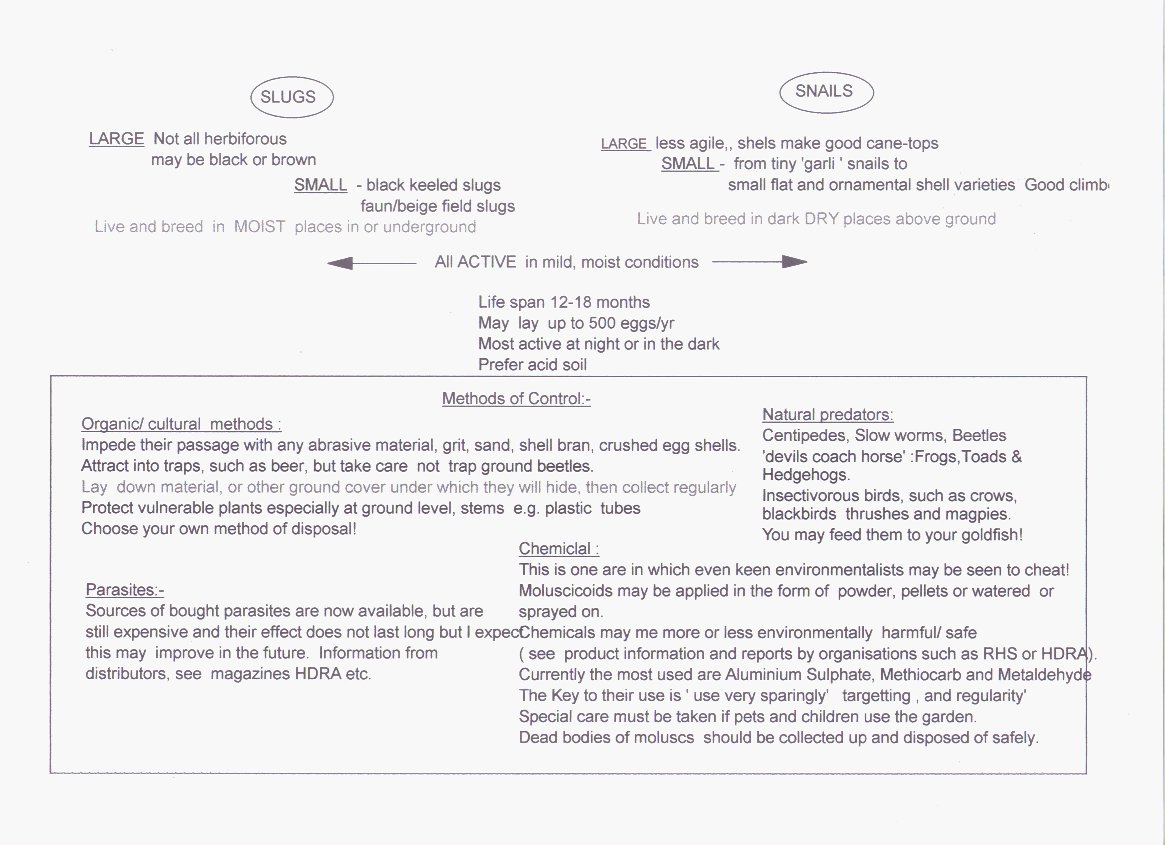
April A tricky month for late frosts - just as new shoots start to grow, new leaves emerge and flowers such as Camelias open. I have a cardboard box with squares of fleece or black (dress) of different sizes round about a meter square with old pegs on the corners. If a late frost is expected it is easy to grab them and just throw them over the most vulnerable plants such as hydrangeas (which if they get frosted now will lose their flower buds), small Acers, advanced rose shoots and anything else that you think may be tender in your garden. It is quick and easy. Protect new growth is just emerging from the ground, from slugs and snails, especially those of the most vulnerable soft shoots of herbaceous perennials such as Delphiniums. Click here for separate paper on slugs and snails Spraying with slug killer during a dry spell, saves using pellets, can be used selectively on some plants, and if foliage is sprayed birds and animals are unlikely to come into contact with it, this is especially good later in the year for those pesky climbing snails you find several feet above the ground chomping away and things like choice climbers! Warm days mean that the grass needs cutting, and now is a good time to spot treat, lawn weeds that kill off the grass - I concentrate only on flat rosette weeds such as dandelion, daisy, plantain and hawkweed & don't bother with the small leaved weeds that mix in with the grass. Aim to cut little and often so that you do not have to take off the cuttings (my lawn care notes) I always find myself doing last minute pruning and moving of plants now, and every year or two I use Pathclear on the shingle paths to keep them clear of weeds, this saves a lot of time. May ---- June - See link HEREJuly --- August --- September ---
Week 3 - Spring Pots Now is a good time to plant up large black pots with spring bulbs and wallflowers for the spring. These can be kept anywhere in the garden or among plants until they die down and until you are ready to clear debris from the borders for the winter. Half fill the pots with good well drained compost, garden soil with some added sharp sand or multipurpose compost and added nutrients. One or more layers of bulbs are added, the smallest at the top, and covered, then Wallflowers or other plants planted on top - e.g. Winter Pansies, Sweet Williams, ground cover plants such as Vinca, or 'spready' perennials too rampant for the garden. Top layer (mulch) with weed free compost or shingle. Water and stand out. Choose colours to mix, match or contrast They can be kept anywhere during the winter, including on your cleared borders, but in the spring put them where you see them best, between plants or shrubs on the borders, as focus plants, on a patio, or by the door. Week 4 - Start Clearing up It is a good idea to get at least some of the clearing up and cutting down of the dead stems of herbaceous perennials, letting them fall onto neighbouring plants can damage them, best get some of the material onto the compost heap. If you have two compost bins, you could start the second one with this 'new' material. Next month it will be time to start getting mature compost out and onto the garden. Non compostioable material and any diseased material should be disposed of out of the garden, burned if you live where this is possible or at the dump if not, you can buy special collection, green bags from the council. Collect up canes, and supports, clean and store dry. Storing pots and plants safe from frost. If you have not already done so, lift or move pots of frost tender plants, and depending on what they are leave to dry off e.g. Dahlias and Lilies and store dry or keep just moist e.g. Fuchsias. If they continue to grow slowly over the winter, store them some where light, if not they can be stored in a shed or garage. ~~~~~~~~~~~~~~~~~~~~~~~~~~~~~~~
|